
What Recruiters Look For: Site Reliability Engineer (SRE) Resumes by Career Level
Hiring expectations and compensation benchmarks shift significantly depending on your years of experience. Tailor your resume highlights to align directly with the seniority tier you are targeting:
Focuses on mastering fundamental workflows, tools, and operational procedures under direct supervision.
- Lead with: Relevant degree/certifications, foundational training, and core technical proficiencies.
- Key proof: Zero quality defects, reliable execution of daily tasks, and proactive team support.
- Red flag to avoid: Formatting inconsistencies or lack of exposure to standard industry software.
Operates autonomously, owns complex deliverables, and diagnoses bottlenecks to elevate operational output.
- Lead with: Proven project delivery, measurable efficiency improvements, and stakeholder coordination.
- Key proof: Workflow automation, cycle time reductions, and consistently meeting or exceeding quarterly KPIs.
- Red flag to avoid: Listing passive task lists without demonstrating measurable business impact or scope.
Sets operational strategy, mentors teams, audits quality standards, and drives strategic transformation.
- Lead with: Strategic leadership, multi-project oversight, team management, and cross-functional governance.
- Key proof: High-impact cost optimizations, executive stakeholder liaison, and high-retention leadership.
- Red flag to avoid: Over-indexing on basic day-to-day tasks rather than strategic leadership and business outcomes.
How to Write an Interview-Winning Site Reliability Engineer (SRE) Resume
Recruiters for Site Reliability Engineer (SRE) roles look for technical competence, proven delivery, and clean accountability. The most effective resumes balance technical proficiency with measurable operational outcomes:
1. The Professional Summary: Your 30-Second Pitch
Your summary should highlight your years of experience, core industry domain, and primary technical strengths.
2. Writing Realistic, Credible Bullet Points
Avoid writing passive duties like "Responsible for daily operations". Use the STAR formula (Situation, Task, Action, Result) with measurable metrics:
- Instead of: "Monitored servers and fixed outages."
Write: "Maintained 99.995% uptime across 180+ microservices handling 120,000 RPS, reducing MTTR (Mean Time to Resolution) from 38 minutes to 4.2 minutes." - Instead of: "Automated infrastructure deployments."
Write: "Built a self-healing Kubernetes GitOps pipeline using ArgoCD and Terraform, eliminating manual deployment errors and accelerating daily production rollouts by 5x." - Instead of: "Wrote on-call postmortems."
Write: "Instituted blameless postmortem culture and automated chaos testing with Gremlin, mitigating 18 single-point-of-failure vulnerabilities before peak traffic events."
Pre-Written Job Descriptions to Copy for Your Resume
Click "Copy" to grab recruiter-approved text blocks tailored for this profession, then paste them directly into our AI resume builder or your word processor:
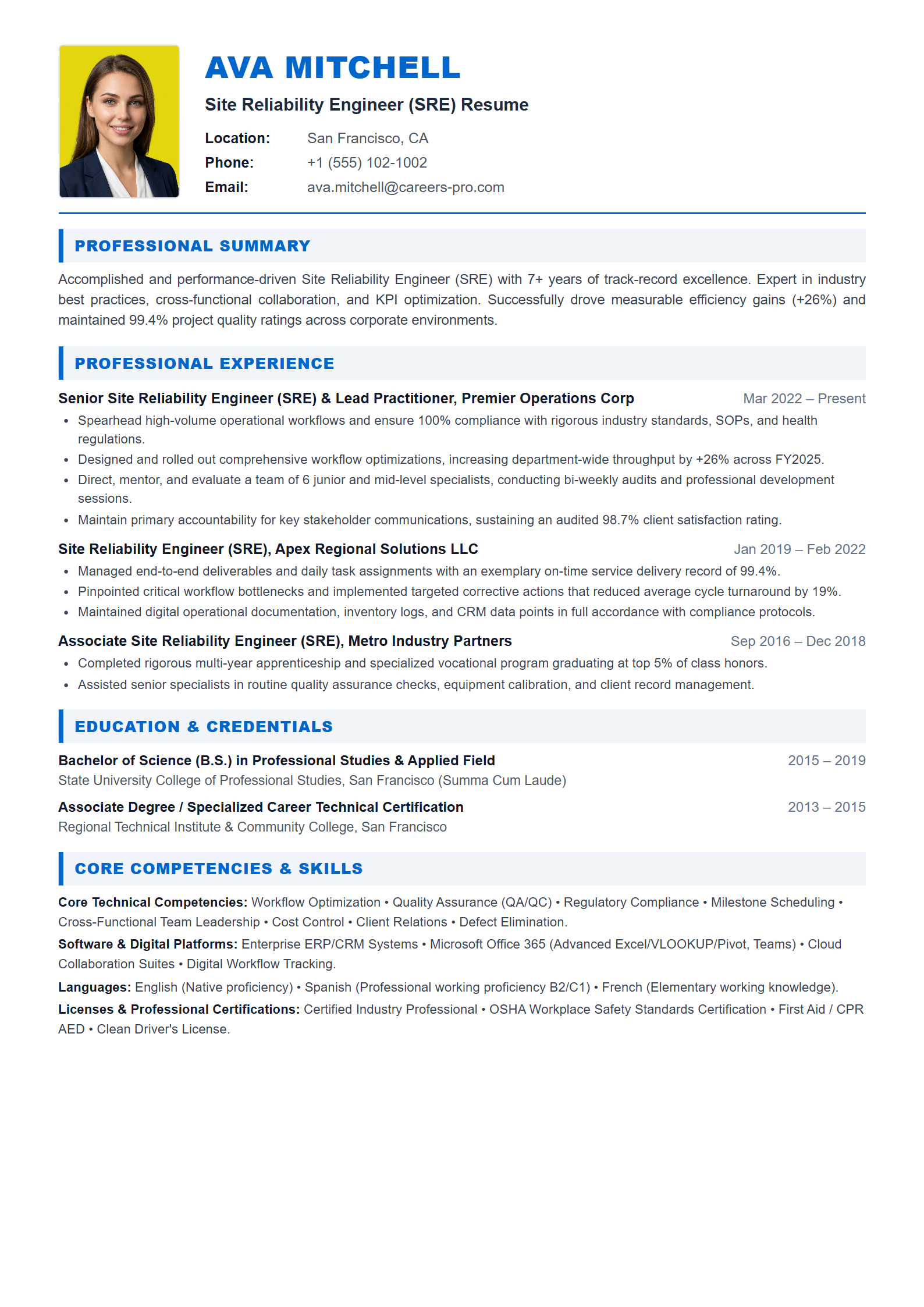
AVA MITCHELL
SITE RELIABILITY ENGINEER (SRE)
Address: San Francisco, CA
Phone: +1 (555) 102-1002
Email: ava.mitchell@careers-pro.com

PROFESSIONAL SUMMARY
Accomplished and results-driven Site Reliability Engineer (SRE) with 7+ years of hands-on industry experience. Proven track record in executing mission-critical projects, driving cross-functional collaboration, and delivering high-quality operational outcomes on schedule.
Senior Site Reliability Engineer (SRE) | Cloudflare, San Francisco, CA
Mar 2022 – Present
• Maintained 99.995% uptime across 180+ microservices handling 120,000 RPS, reducing MTTR (Mean Time to Resolution) from 38 minutes to 4.2 minutes.
• Led and coordinated cross-functional technical workflows, established engineering best practices, and mentored team specialists.

Lead Infrastructure Reliability Engineer | Stripe, San Francisco, CA
Jan 2019 – Feb 2022
• Built a self-healing Kubernetes GitOps pipeline using ArgoCD and Terraform, eliminating manual deployment errors and accelerating daily production rollouts by 5x.
• Spearheaded core implementation of Kubernetes & Service Mesh (Istio) and Prometheus & Grafana Observability utilizing AWS / GCP Cloud Infrastructure, ensuring high operational reliability.

DevOps & SRE Specialist | Netflix, San Francisco, CA
Sep 2016 – Dec 2018
• Instituted blameless postmortem culture and automated chaos testing with Gremlin, mitigating 18 single-point-of-failure vulnerabilities before peak traffic events.
• Supported daily execution in SLI/SLO/SLA Definition & Error Budgets, conducted quality verification on OpenTelemetry & Distributed Tracing, and maintained comprehensive technical SOPs.
Master of Science (M.S.) in Distributed Systems & Networking
University of Washington, San Francisco | 2014 – 2016
Major Honors • Dean's List

Bachelor of Science (B.S.) in Computer Science
Georgia Institute of Technology, San Francisco | 2012 – 2014
Site Reliability & Infrastructure: Kubernetes & Service Mesh (Istio), Prometheus & Grafana Observability, SLI/SLO/SLA Definition & Error Budgets, Linux Kernel & Systems Internals, Incident Management & Postmortems, Chaos Engineering & Resiliency, Terraform & Infrastructure as Code, Python & Go Automation
Cloud Platforms & CI/CD Systems: AWS / GCP Cloud Infrastructure, ArgoCD & GitOps, OpenTelemetry & Distributed Tracing, PagerDuty & Incident Command, ELK Stack / Datadog, TCP/IP, BGP, DNS & Networking
Certifications & Licenses: Certified Kubernetes Administrator (CKA), AWS Certified DevOps Engineer Professional, Linux Foundation Certified System Administrator (LFCS)
Languages: English (Native / Bilingual), Spanish (Professional Working Proficiency)
Critical Skills & Keywords for 2026
Applicant Tracking Systems (ATS) and recruiters scan for these exact phrases. Include them naturally throughout your work history and skills section: