
What Recruiters Look For: Machine Learning Engineer Resumes by Career Level
Hiring expectations shift significantly depending on your years of experience. Tailor your resume highlights to align directly with the seniority tier you are targeting:
Recruiters prioritize clean coding fundamentals, data structures, Git versioning, and demonstrated enthusiasm to learn modern frameworks.
- Lead with: Degree / CS coursework, active GitHub repositories, and capstone full-stack projects.
- Key proof: Functional API integrations, automated test suites, and clean documentation in pull requests.
- Red flag to avoid: Claiming to be an "expert" in 15 languages without demonstrable codebase history.
Recruiters seek independent feature ownership, database optimization, cloud deployments, and dependable agile delivery.
- Lead with: Quantified performance optimizations (latency reduction, API throughput, query tuning).
- Key proof: Production releases, microservices architecture, AWS/GCP infrastructure, and CI/CD pipelines.
- Red flag to avoid: Passive bullet points like "wrote code and fixed bugs" without citing technical scale or metrics.
Focus shifts from individual code output to high-level architecture decisions, mentoring engineers, and aligning tech with business KPIs.
- Lead with: Executive summary highlighting system scale, architectural strategy, and team mentorship.
- Key proof: High-availability distributed architectures (99.99% SLA), 25%+ cloud cost savings, and tech roadmaps.
- Red flag to avoid: Focusing strictly on low-level syntax while ignoring business ROI, team leadership, and cross-team influence.
How to Write an Interview-Winning Machine Learning Engineer Resume
Recruiters for machine learning engineer roles look for technical competence, proven delivery, and clean accountability. The most effective resumes balance technical proficiency with measurable operational outcomes:
1. The Professional Summary: Your 30-Second Pitch
Your summary should highlight your years of experience, core industry domain, and primary technical strengths.
2. Writing Realistic, Credible Bullet Points
Avoid writing passive duties like "Responsible for daily operations" or exaggerated claims. Focus on genuine scope and process ownership:
- Instead of: "Worked on daily projects and tasks."
Write: "Architected production LLM fine-tuning and retrieval-augmented generation (RAG) pipeline utilizing PyTorch, LangChain, and Qdrant vector database." - Instead of: "Helped improve team procedures."
Write: "Reduced model inference latency from 240ms to 85ms using TensorRT acceleration, quantization (INT8/FP16), and Triton Inference Server." - Instead of: "Communicated with clients and partners."
Write: "Built automated MLOps pipelines with Kubeflow and MLflow, enabling daily automated continuous model retraining and drift detection."
Copy-Paste Ready Resume Content
Click "Copy Text" to grab these pre-formatted sections and paste them into our AI Resume Builder or your own word processor:
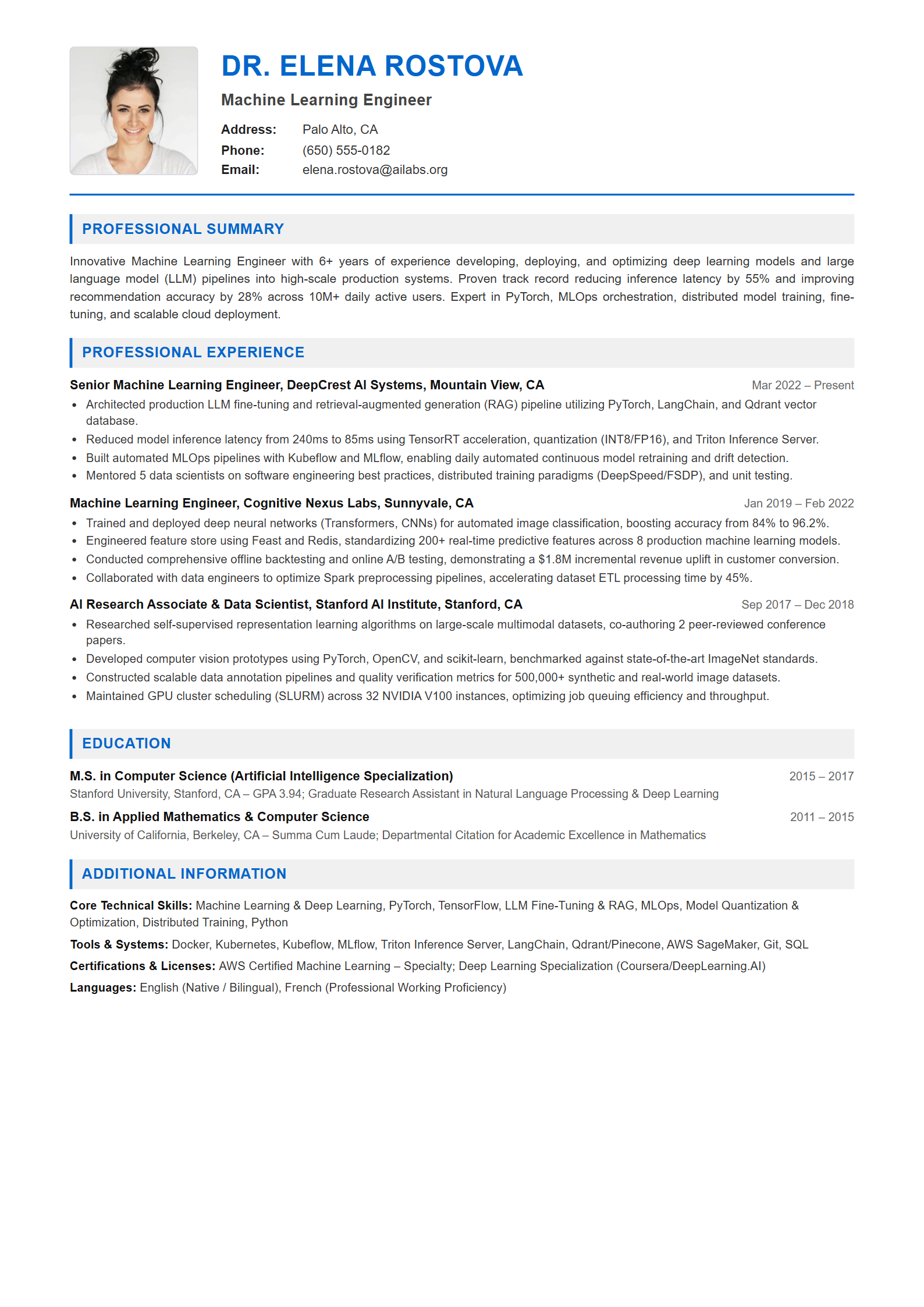
DR. ELENA ROSTOVA
Machine Learning Engineer
Address: Palo Alto, CA
Phone: (650) 555-0182
Email: elena.rostova@ailabs.org

PROFESSIONAL SUMMARY
Innovative Machine Learning Engineer with 6+ years of experience developing, deploying, and optimizing deep learning models and large language model (LLM) pipelines into high-scale production systems. Proven track record reducing inference latency by 55% and improving recommendation accuracy by 28% across 10M+ daily active users. Expert in PyTorch, MLOps orchestration, distributed model training, fine-tuning, and scalable cloud deployment.
Senior Machine Learning Engineer | DeepCrest AI Systems, Mountain View, CA
Mar 2022 – Present
• Architected production LLM fine-tuning and retrieval-augmented generation (RAG) pipeline utilizing PyTorch, LangChain, and Qdrant vector database.
• Reduced model inference latency from 240ms to 85ms using TensorRT acceleration, quantization (INT8/FP16), and Triton Inference Server.
• Built automated MLOps pipelines with Kubeflow and MLflow, enabling daily automated continuous model retraining and drift detection.
• Mentored 5 data scientists on software engineering best practices, distributed training paradigms (DeepSpeed/FSDP), and unit testing.

Machine Learning Engineer | Cognitive Nexus Labs, Sunnyvale, CA
Jan 2019 – Feb 2022
• Trained and deployed deep neural networks (Transformers, CNNs) for automated image classification, boosting accuracy from 84% to 96.2%.
• Engineered feature store using Feast and Redis, standardizing 200+ real-time predictive features across 8 production machine learning models.
• Conducted comprehensive offline backtesting and online A/B testing, demonstrating a $1.8M incremental revenue uplift in customer conversion.
• Collaborated with data engineers to optimize Spark preprocessing pipelines, accelerating dataset ETL processing time by 45%.

AI Research Associate & Data Scientist | Stanford AI Institute, Stanford, CA
Sep 2017 – Dec 2018
• Researched self-supervised representation learning algorithms on large-scale multimodal datasets, co-authoring 2 peer-reviewed conference papers.
• Developed computer vision prototypes using PyTorch, OpenCV, and scikit-learn, benchmarked against state-of-the-art ImageNet standards.
• Constructed scalable data annotation pipelines and quality verification metrics for 500,000+ synthetic and real-world image datasets.
• Maintained GPU cluster scheduling (SLURM) across 32 NVIDIA V100 instances, optimizing job queuing efficiency and throughput.
M.S. in Computer Science (Artificial Intelligence Specialization)
Stanford University, Stanford, CA | 2015 – 2017
Stanford University, Stanford, CA – GPA 3.94; Graduate Research Assistant in Natural Language Processing & Deep Learning

B.S. in Applied Mathematics & Computer Science
University of California, Berkeley, CA | 2011 – 2015
University of California, Berkeley, CA – Summa Cum Laude; Departmental Citation for Academic Excellence in Mathematics
Core Competencies: Machine Learning & Deep Learning, PyTorch, TensorFlow, LLM Fine-Tuning & RAG, MLOps, Model Quantization & Optimization, Distributed Training, Python
Tools & Systems: Docker, Kubernetes, Kubeflow, MLflow, Triton Inference Server, LangChain, Qdrant/Pinecone, AWS SageMaker, Git, SQL
Certifications & Licenses: AWS Certified Machine Learning – Specialty; Deep Learning Specialization (Coursera/DeepLearning.AI)
Languages: English (Native / Bilingual), French (Professional Working Proficiency)
Essential Machine Learning Engineer Keywords for 2026
Ensure your resume includes these core technical competencies and software systems to match recruiter search queries: