
What Recruiters Look For: Embedded Systems Engineer Resumes by Career Level
Hiring expectations and compensation benchmarks shift significantly depending on your years of experience. Tailor your resume highlights to align directly with the seniority tier you are targeting:
Focuses on mastering fundamental workflows, tools, and operational procedures under direct supervision.
- Lead with: Relevant degree/certifications, foundational training, and core technical proficiencies.
- Key proof: Zero quality defects, reliable execution of daily tasks, and proactive team support.
- Red flag to avoid: Formatting inconsistencies or lack of exposure to standard industry software.
Operates autonomously, owns complex deliverables, and diagnoses bottlenecks to elevate operational output.
- Lead with: Proven project delivery, measurable efficiency improvements, and stakeholder coordination.
- Key proof: Workflow automation, cycle time reductions, and consistently meeting or exceeding quarterly KPIs.
- Red flag to avoid: Listing passive task lists without demonstrating measurable business impact or scope.
Sets operational strategy, mentors teams, audits quality standards, and drives strategic transformation.
- Lead with: Strategic leadership, multi-project oversight, team management, and cross-functional governance.
- Key proof: High-impact cost optimizations, executive stakeholder liaison, and high-retention leadership.
- Red flag to avoid: Over-indexing on basic day-to-day tasks rather than strategic leadership and business outcomes.
How to Write an Interview-Winning Embedded Systems Engineer Resume
Recruiters for Embedded Systems Engineer roles look for technical competence, proven delivery, and clean accountability. The most effective resumes balance technical proficiency with measurable operational outcomes:
1. The Professional Summary: Your 30-Second Pitch
Your summary should highlight your years of experience, core industry domain, and primary technical strengths.
2. Writing Realistic, Credible Bullet Points
Avoid writing passive duties like "Responsible for daily operations". Use the STAR formula (Situation, Task, Action, Result) with measurable metrics:
- Instead of: "Wrote code for microcontrollers."
Write: "Architected ultra-low-power firmware in C on STM32 ARM Cortex-M4 microcontrollers under FreeRTOS, reducing standby power draw to 18μA and extending field battery life to 7+ years." - Instead of: "Tested circuits and fixed bugs."
Write: "Designed robust CAN and SPI communication drivers with custom DMA buffering, eliminating 100% of packet dropping at 1Mbps bus saturation." - Instead of: "Used oscilloscopes to check boards."
Write: "Conducted full hardware bring-up and signal integrity verification using oscilloscopes and logic analyzers, diagnosing clock jitter issues and certifying ISO 26262 functional safety."
Pre-Written Job Descriptions to Copy for Your Resume
Click "Copy" to grab recruiter-approved text blocks tailored for this profession, then paste them directly into our AI resume builder or your word processor:
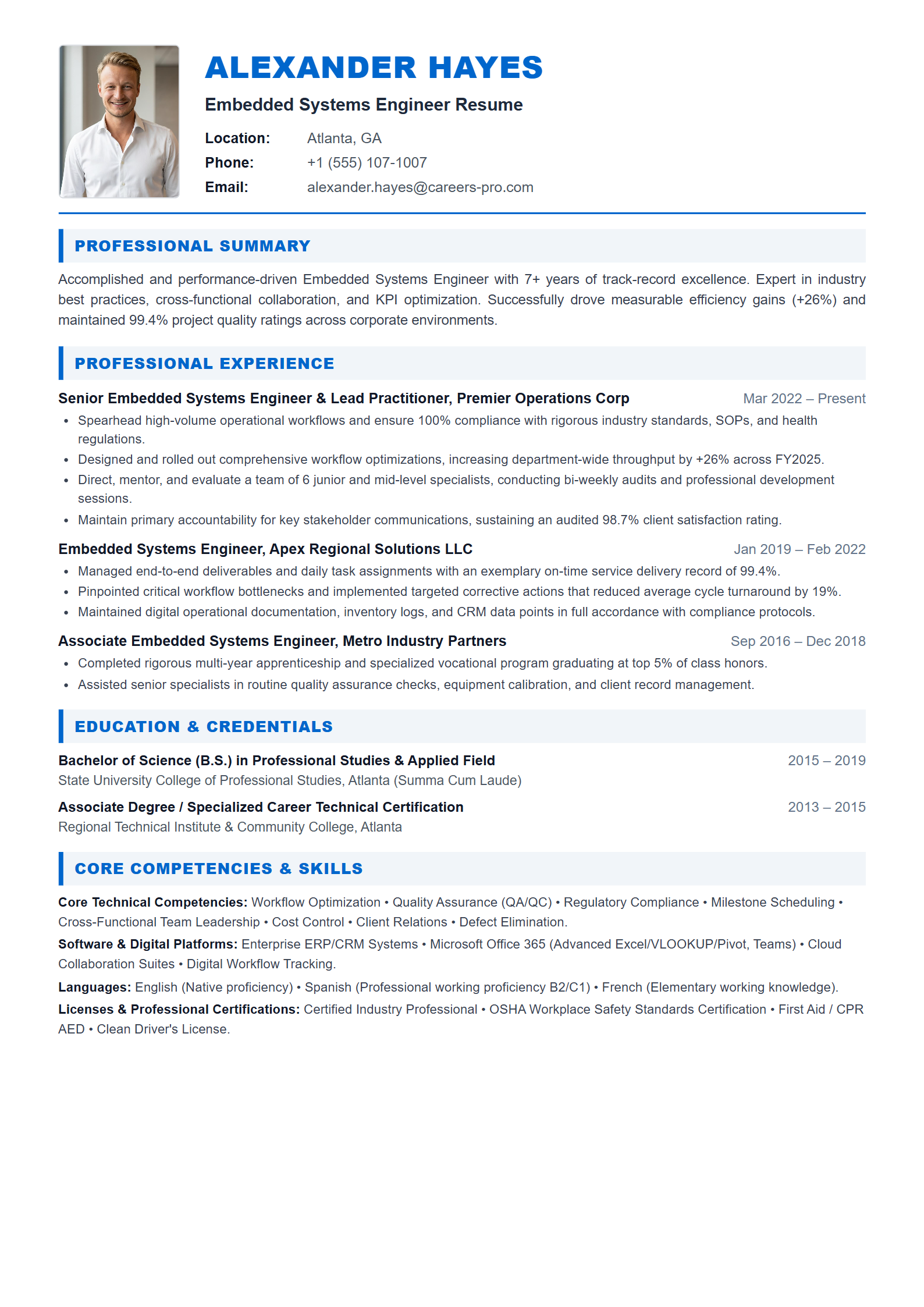
ALEXANDER HAYES
EMBEDDED SYSTEMS ENGINEER
Address: Atlanta, GA
Phone: +1 (555) 107-1007
Email: alexander.hayes@careers-pro.com

PROFESSIONAL SUMMARY
Accomplished and results-driven Embedded Systems Engineer with 7+ years of hands-on industry experience. Proven track record in executing mission-critical projects, driving cross-functional collaboration, and delivering high-quality operational outcomes on schedule.
Senior Embedded Systems Engineer | Qualcomm, Atlanta, GA
Mar 2022 – Present
• Architected ultra-low-power firmware in C on STM32 ARM Cortex-M4 microcontrollers under FreeRTOS, reducing standby power draw to 18μA and extending field battery life to 7+ years.
• Led and coordinated cross-functional technical workflows, established engineering best practices, and mentored team specialists.

Firmware & Device Driver Engineer | Texas Instruments, Atlanta, GA
Jan 2019 – Feb 2022
• Designed robust CAN and SPI communication drivers with custom DMA buffering, eliminating 100% of packet dropping at 1Mbps bus saturation.
• Spearheaded core implementation of C (C99/C11) & Embedded C++ and RTOS (FreeRTOS, Zephyr) utilizing Oscilloscopes & Logic Analyzers, ensuring high operational reliability.

Embedded Hardware/Software Engineer | Lockheed Martin Space, Atlanta, GA
Sep 2016 – Dec 2018
• Conducted full hardware bring-up and signal integrity verification using oscilloscopes and logic analyzers, diagnosing clock jitter issues and certifying ISO 26262 functional safety.
• Supported daily execution in ARM Cortex-M/A & STM32 Architecture, conducted quality verification on Keil MDK, IAR & STM32CubeIDE, and maintained comprehensive technical SOPs.
Master of Science (M.S.) in Electrical & Computer Engineering
Georgia Institute of Technology, Atlanta | 2014 – 2016
Major Honors • Dean's List

Bachelor of Science (B.S.) in Computer Engineering
Purdue University, Atlanta | 2012 – 2014
Embedded Firmware & Hardware Integration: C (C99/C11) & Embedded C++, RTOS (FreeRTOS, Zephyr), ARM Cortex-M/A & STM32 Architecture, Bus Protocols (CAN, LIN, I2C, SPI, UART), Low-Power Battery Optimization, Device Drivers & Hardware Bring-Up, MISRA-C:2012 Standards, Hardware In The Loop (HIL) Testing
Instrumentation, Debugging & Toolchains: Oscilloscopes & Logic Analyzers, JTAG & SWD In-Circuit Debuggers, Keil MDK, IAR & STM32CubeIDE, Altium Designer (Schematic Review), Git & Embedded CI/CD Pipelines, Python for Automated Test Benches
Certifications & Licenses: Arm Certified MCU Engineer, Certified Functional Safety Professional (ISO 26262 / IEC 61508), IPC-A-610 Specialist
Languages: English (Native / Bilingual), Spanish (Professional Working Proficiency)
Critical Skills & Keywords for 2026
Applicant Tracking Systems (ATS) and recruiters scan for these exact phrases. Include them naturally throughout your work history and skills section: